
Many people believe problematic behaviours begin with a lack of willpower or discipline. But often, the behaviour itself is only the visible part of a much deeper internal cycle.
Whether it shows up as emotional eating, overworking, people-pleasing, shutting down, excessive scrolling, anger outbursts, substance use, perfectionism, avoidance, or relationship conflict, many of us find ourselves reacting automatically when stress, discomfort, or emotional overwhelm builds.
Understanding this cycle can help us respond with greater awareness, self-compassion, and choice.
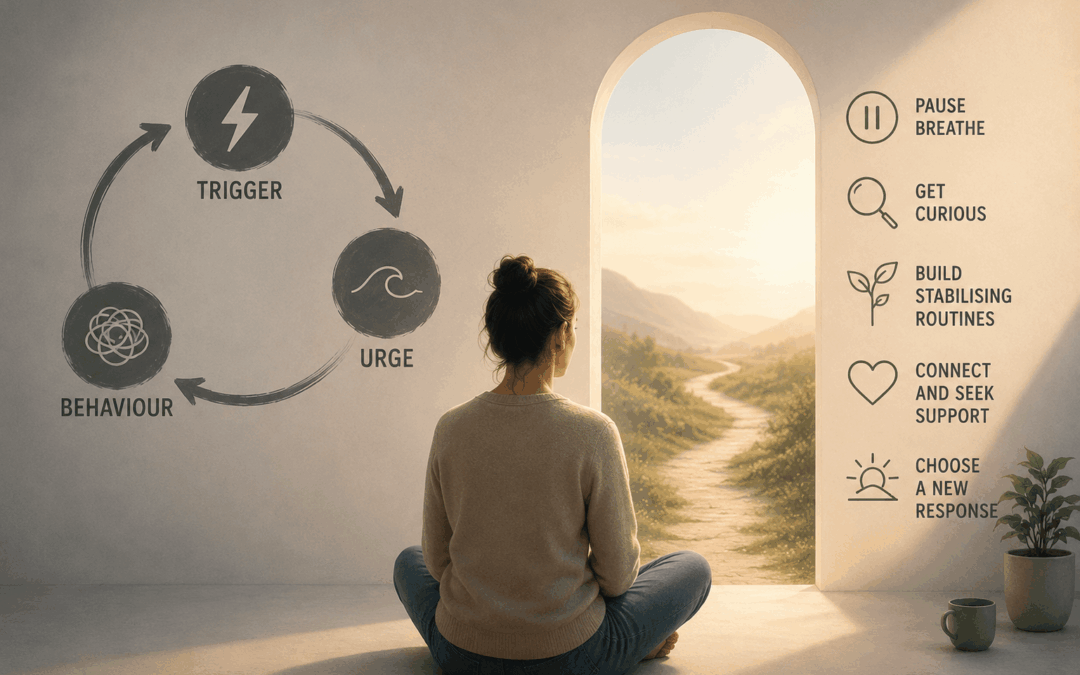
Understanding the Trigger–Urge–Behaviour Cycle
The cycle often begins with a trigger. Triggers can be external, such as conflict, pressure, criticism, loneliness, financial stress, or uncertainty. They can also be internal, including emotions, thoughts, memories, physical exhaustion, or self-doubt.
A trigger creates discomfort inside the nervous system. The mind then searches for relief.
This often leads to an urge: the pull toward a familiar coping strategy that promises temporary comfort, escape, control, distraction, or soothing.
The behaviour itself may provide short-term relief, but it often comes with longer-term consequences such as shame, exhaustion, disconnection, regret, or increased stress. These consequences then become new triggers, and the cycle continues.
According to Brewer and Pbert (2015), this pattern reflects a classic habit loop:
trigger → behaviour → reward.
Our brains are wired to repeat behaviours that bring fast relief, even when those behaviours no longer serve us well.
Why These Patterns Feel So Difficult to Change
These responses are not signs of weakness or failure. They are often deeply learned survival strategies.
When the brain perceives emotional discomfort or threat, it naturally looks for the quickest route back to safety or certainty. Over time, repeated behaviours become automatic neural pathways.
This is where Positive Intelligence offers a helpful lens.
Positive Intelligence describes how many of our reactive patterns are driven by “Saboteurs” — automatic mental habits rooted in fear, self-protection, judgment, anxiety, control, avoidance, or hyper-achievement. These Saboteurs often convince us that our coping strategies are necessary for survival, even when they leave us depleted or disconnected.
Examples may include:
- The Pleaser who cannot say no and becomes emotionally exhausted
- The Hyper-Achiever who ties worth to productivity
- The Avoider who disconnects from difficult emotions
- The Controller who struggles with uncertainty
- The Hyper-Vigilant mind constantly scanning for danger or mistakes
These patterns are not inherently bad. They often developed to help us cope. But when they become automatic, they can keep us stuck in cycles of stress, reactivity, and self-defeating behaviour.
What Keeps the Cycle Going?
Several factors can reinforce these automatic loops:
- Emotional avoidance
Difficult feelings such as grief, fear, shame, anger, or vulnerability can feel overwhelming, leading us to seek immediate relief. - Chronic stress and nervous system overload
When the nervous system remains in survival mode for long periods, reactive behaviours become more likely. - Harsh self-criticism
Shame and self-judgment often deepen the cycle rather than interrupt it. - Unmet emotional needs
Loneliness, exhaustion, lack of support, or unresolved emotional pain can quietly fuel unhealthy coping patterns. - Lack of awareness
Many behaviours happen so automatically that we react before we even realise we have been triggered.
Gentle Ways to Interrupt the Cycle
Change rarely happens through self-criticism alone. Sustainable change begins with awareness, curiosity, and small intentional shifts.
1. Name the pattern without shaming yourself
Awareness creates space between the trigger and the reaction.
Simply noticing:
“I feel triggered.”
“I notice the urge to escape.”
“My inner critic is loud right now.”
can reduce automatic reactivity.
In Positive Intelligence, this is the beginning of shifting from Saboteur mode into Sage mode — moving from judgment and fear toward curiosity and wiser response.
2. Pause before reacting
Even a brief pause helps regulate the nervous system.
Small grounding practices can help:
- Taking three slow breaths
- Feeling your feet on the floor
- Noticing physical sensations
- Drinking water slowly
- Stepping outside for fresh air
These moments strengthen the brain’s ability to respond rather than react automatically.
3. Get curious about the real need underneath the urge
Often, the behaviour itself is not the real issue. It is an attempt to meet an unmet need.
You might ask yourself:
- What am I actually needing right now?
- Am I seeking comfort, rest, reassurance, connection, control, or relief?
- What emotion am I struggling to tolerate?
- What would support look like in this moment?
Curiosity tends to create more change than self-attack.
4. Rebuild small stabilising routines
Stress and emotional overwhelm often disrupt structure and self-care.
Simple routines can help restore emotional stability:
- Eating regularly
- Sleeping consistently
- Going for short walks
- Reducing overstimulation
- Checking in with supportive people
- Creating small moments of recovery during the day
Small repeated actions often create bigger shifts than dramatic changes.
5. Strengthen supportive connection
Healing rarely happens in isolation.
Supportive relationships, counselling, support groups, trusted friends, coaching, or emotionally safe communities can help interrupt cycles of shame and disconnection.
Connection helps regulate the nervous system and reminds us that we do not have to carry everything alone.
Final Thoughts
Being triggered does not mean you are failing.
It means you are human.
Many of the behaviours we judge ourselves for began as attempts to cope, survive, protect ourselves, or manage emotional pain.
Growth is not about becoming perfectly regulated or never struggling again. It is about developing greater awareness, learning to pause, and gradually responding differently to ourselves when life feels difficult.
Over time, even small moments of awareness can begin to rewire old patterns and create healthier ways of coping.
And that process starts not with shame, but with understanding.
References
- Brewer, J., & Pbert, L. (2015). Mindfulness: An emerging treatment for smoking and other addictions? Journal of Family Medicine, 2(8), 1035.
- Melemis, S. M. (2015). Relapse prevention and the five rules of recovery. Yale Journal of Biology and Medicine, 88(3), 325–332.
- Centre for Clinical Interventions. (2021). Urge Surfing / Emotion Surfing.
- Chamine, S. (2012). Positive Intelligence: Why Only 20% of Teams and Individuals Achieve Their True Potential and How You Can Achieve Yours.
Recent Comments